In [159]:


from jupyter_cms.loader import load_notebook

eda = load_notebook('./data_exploration.ipynb')

df, newspapers = eda.load_data()
These slugs were chosen from the Wikipedia page of widely circulated newspapers in the United States: https://en.wikipedia.org/wiki/List_of_newspapers_in_the_United_States#By_circulation. Unfortunately it seems like that list was using 2013 data, but I recognize enough of these papers as major that it's a close-enough approximation.
Also we have to leave the NYT and New York Post out, unfortunately, since pdfminer extracted their characters without being able to group them into lines and paragraphs. If taking character-level data and massaging it into paragraphs sounds like a fun task for you, please drop a Github issue or otherwise get in touch :)
In [177]:


slugs_of_interest = [
    'WSJ',
    'USAT',
    'CA_LAT',
    'CA_MN',
    'NY_DN',
    'DC_WP',
    'IL_CST',
    'CO_DP',
    'IL_CT',
    'TX_DMN'
]
In [160]:


import pandas as pd
from datetime import datetime

pd.set_option('display.max_columns', 100)

df.head(2)
Out[160]:
In [165]:


df['month'] = df['date'].apply(lambda x: x.month)
In [226]:


def print_row(i, row):
    print("#{i}: {title} — {date:%b. %-d} — {fontsize:.2f}pt".format(
        i=i + 1,
        title=" ".join(row.text.split()),
        date=row.date,
        fontsize=row.fontsize))

def largest_font_headlines(npdf, paper):
    npdf = npdf[(npdf.bbox_top > npdf.page_height / 2) & (npdf.month >= 6)]
    top = npdf.sort_values(by='fontsize', ascending=False).head(10)
    print(paper)
    for i, (_, row) in enumerate(top.iterrows()):
        print_row(i, row)
In [227]:


# Um, definitely should have a better place for doing this, but on Dec 18th the WSJ PDF I archived was actually
# a different newspaper, somehow. I wonder if it's a Newseum error, but they don't keep their archives up beyond a day

largest_font_headlines(df[(df.slug == 'WSJ') & (df.date != datetime(2017, 12, 18))], 'The Wall Street Journal')

print()

largest_font_headlines(df[df.slug == 'USAT'], 'USA Today')

print()

largest_font_headlines(df[df.slug == 'CA_LAT'], 'Los Angeles Times')

print()

largest_font_headlines(df[df.slug == 'CA_MN'], 'San Jose Mercury News')

print()

largest_font_headlines(df[df.slug == 'NY_DN'], 'New York Daily News')

print()

largest_font_headlines(df[df.slug == 'DC_WP'], 'The Washington Post')

print()

largest_font_headlines(df[df.slug == 'IL_CST'], 'Chicago Sun Times')

print()

largest_font_headlines(df[df.slug == 'CO_DP'], 'The Denver Post')

print()

largest_font_headlines(df[df.slug == 'IL_CT'], 'Chicago Tribune')

print()

largest_font_headlines(df[df.slug == 'TX_DMN'], 'The Dallas Morning News')
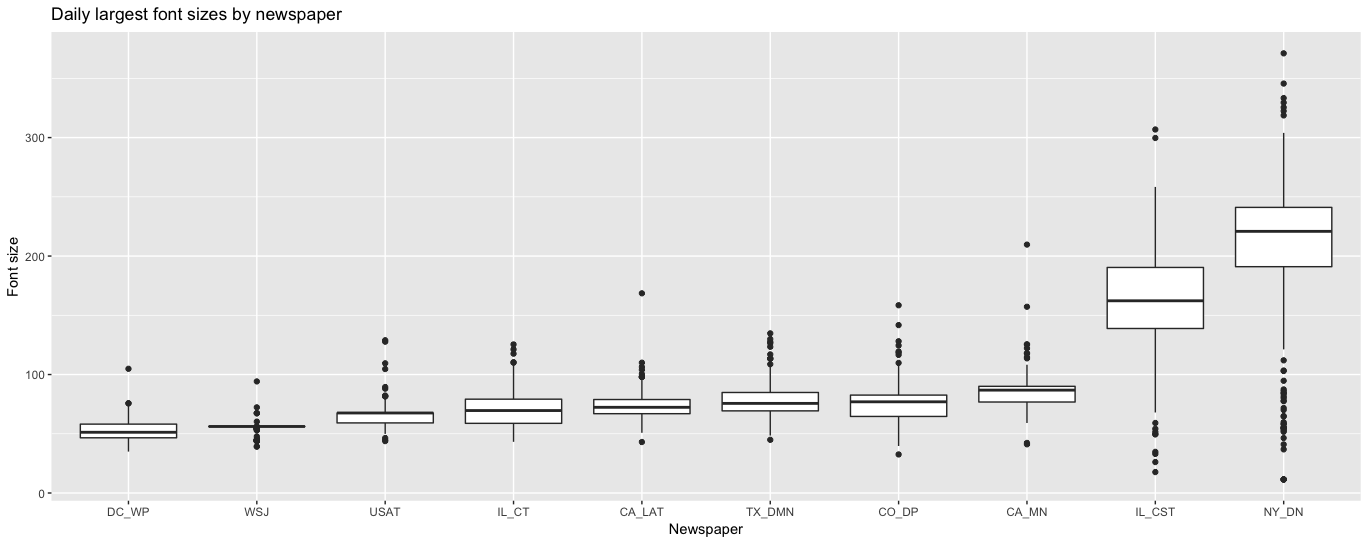
So what else can we learn from the top sized headlines on these journals?
/ insert intermission where I switch into R and run ggplot to generate this graph: link. Look at that graph if you haven't yet because it motivates some of the following.
We can see a wide distribution of biggest-headlines-per-day (what I'll ignorantly call the "splash" headline, please let me know if you know of the actual newspaper jargon) for each major newspaper. On the right-hand side, the tabloids tend to be extremely generous with how they use fonts. Let's see if that holds up at large.
As a refresher, here are some common newspaper formats from Wikipedia:
    Diver's Dispatch 914.4 mm × 609.6 mm (36.00 in × 24.00 in) (1.5)
    Broadsheet 749 mm × 597 mm (29.5 in × 23.5 in) (1.255)
    Nordisch 570 mm × 400 mm (22 in × 16 in) (1.425)
    Rhenish around 350 mm × 520 mm (14 in × 20 in) (1.486)
    Swiss (Neue Zürcher Zeitung) 475 mm × 320 mm (18.7 in × 12.6 in) (1.484)
    Berliner 470 mm × 315 mm (18.5 in × 12.4 in) (1.492)
        The Guardian's printed area is 443 mm × 287 mm (17.4 in × 11.3 in).[2]
    Tabloid 430 mm × 280 mm (17 in × 11 in) (1.536)
We'll mainly just look at the height here for simplicity's sake.
Note these numbers will be slightly off since:
In [250]:


%matplotlib inline
import matplotlib.pyplot as plt
import seaborn as sns

sns.distplot(df.groupby(['slug']).page_height.first())
plt.suptitle("Distribution of page heights (by pixels)")
Out[250]:
So it looks like most of our newspapers are clustered around the 1600px height. But what is that in inches? Let's do a few known papers to check.
In [245]:


print('''Heights of known papers:

Broadsheets:
The Washington Post: {}px
The Wall Street Journal: {}px

Tabloids:
The Chicago Sun Times: {}px
The New York Daily News: {}px
'''.format(
    df[df.slug == 'DC_WP'].page_height.mode().iloc[0],
    df[df.slug == 'WSJ'].page_height.mode().iloc[0],
    df[df.slug == 'IL_CST'].page_height.mode().iloc[0],
    df[df.slug == 'NY_DN'].page_height.mode().iloc[0]
))
In [244]:


print('''Aspect ratios of known papers:

Broadsheets:
The Washington Post: {}
The Wall Street Journal: {}

Tabloids:
The Chicago Sun Times: {}
The New York Daily News: {}
'''.format(
    df[df.slug == 'DC_WP'].aspect_ratio.mode().iloc[0],
    df[df.slug == 'WSJ'].aspect_ratio.mode().iloc[0],
    df[df.slug == 'IL_CST'].aspect_ratio.mode().iloc[0],
    df[df.slug == 'NY_DN'].aspect_ratio.mode().iloc[0]
))
By our very rough check, the two broadsheets tended to be >1500px height with an aspect ratio around 1:2, and the tabloids are shorter with an aspect ratio around 1.
Let's see how this plays out with font sizes.
In [292]:


from scipy import stats
import numpy as np

def mode(heights):
    return stats.mode(heights).mode[0]

daily_headlines = df.groupby(['date', 'slug']).agg({'fontsize': max, 'page_height': mode, 'aspect_ratio': mode})
In [293]:


daily_headlines.head()
Out[293]:
In [294]:


avg_size_by_paper = daily_headlines.reset_index().groupby('slug').agg({'fontsize': np.mean, 'page_height': mode, 'aspect_ratio': mode, 'slug': 'count'}).rename(columns={'slug': 'n'})
avg_size_by_paper.head()
Out[294]:
In [295]:


sns.distplot(avg_size_by_paper['n'], kde=False, bins=30)
plt.xlim([0, 250])
plt.suptitle("Distribution of number of days each paper has records in the scrape")

avg_size_by_paper['n'].describe()
Out[295]:
In [296]:


avg_size_highly_present = avg_size_by_paper[avg_size_by_paper['n'] > 182]  # more than the median
In [318]:


sns.regplot(avg_size_highly_present.page_height, avg_size_highly_present.fontsize, fit_reg=False)
plt.xlabel("Page height in pixels")
plt.ylabel("Average font point of day's largest headline")
plt.suptitle("Each dot is a newspaper")
Out[318]:
In [317]:


sns.regplot(avg_size_highly_present.aspect_ratio, avg_size_highly_present.fontsize, x_jitter=0.01, fit_reg=False)
plt.xlabel("Aspect ratio (width/height)")
plt.ylabel("Average font point of day's largest headline")
plt.suptitle("Each dot is a newspaper")
Out[317]:
In [310]:


sns.regplot(avg_size_highly_present.aspect_ratio, avg_size_highly_present.fontsize, x_jitter=0.05, fit_reg=False)
Out[310]:
Three observations:
So what are those outliers?
In [306]:


avg_size_highly_present.sort_values(by='fontsize', ascending=False).head(10)
Out[306]:
The biggest outliers with font size for tabloids turned out to be the ones in our most-circulated newspaper dataset, so my prior was skewed toward the large size. However, all 5 of the biggest font-using newspapers were "tabloids", so there is some truth to it. The data is a bit too categorical between broadsheet and tabloid, and I'm too fuzzy on the space in between, to make any overarching conclusions!
Let's go back and double-check how closely the height maps to the aspect ratio.
In [312]:


sns.regplot(avg_size_highly_present.aspect_ratio, avg_size_highly_present.page_height, x_jitter=0.01, fit_reg=False)
Out[312]: